
Updated: Jul 8
Banksy’s art embodies all the misery and hopes migrants experience on their perilous journeys
Banksy's audience is not the migrants themselves, who are unlikely to see his murals. Instead, his work targets those comfortably embedded in Western society. Its aim is to make turning away a little more difficult.
By The Immigrant Times

Banksy’s latest statue, erected near Buckingham Palace on 30 April 2026, is believed to criticise blind nationalism. During the Venice Biennale in May 2019, a Banksy piece appeared just above the waterline on a canal-facing wall. It depicted a child in a life vest holding a pink smoke flare, a figure symbolising the thousands of children who had crossed the Mediterranean in those years, and the distress signals sent by those who did not survive the crossing.
Blinded by nationalism
May 2026: On 30 April 2026, a new statue appeared on Waterloo Place in central London, blending seamlessly among the bronze and granite monuments of St James’s as if it had always been there. The figure is dressed appropriately, with a dignified stance, yet the large flag he carries completely covers his face, blinding him as he steps forward halfway off the plinth.
The colouring of both the statue and its base reflects that of the nearby Victorian monuments: the Duke of York Column, the Guards Crimean War memorial, and statues of Florence Nightingale and Lord Lea. How and when it was erected in one of London’s busiest intersections went unreported until the morning crowds started to gather.
The signature carved into the plinth confirmed the work as Banksy’s, and the artist later verified it. According to the BBC, the figure is believed to symbolise a critique of nationalism: a man so absorbed by the flag he waves that he cannot see where he is heading. It is, as usual, a statement conveyed without a single spoken word.
The Waterloo Place statue is the latest in a body of work spanning over a decade, a sustained, sometimes striking engagement with one of the defining political questions of our era: how societies treat people who cross borders in search of safety or a better life.
No artist of comparable fame has addressed the migrant experience with greater consistency or inventiveness. Banksy has painted in refugee camps, funded rescue ships, transformed hotel rooms into political statements, and sold welcome mats made from the life vests of people who nearly drowned.
Banksy's audience is not the migrants themselves, who are unlikely to see his murals. Instead, his work targets those comfortably embedded in Western society, the distracted, and the politically disengaged. Its aim is to make turning away a little more difficult.

The Birds of Clacton (2014)
In September 2014, a mural appeared on a wall in Clacton-on-Sea, Essex. It showed five grey pigeons perched on a wire, each holding a sign. The messages read “Migrants Not Welcome,” “Go Back to Africa,” and “Keep Off Our Worms.” The targets of this hostility were a single, more colourful bird, an exotic swallow, keeping its distance along the same wire.
The timing was exact. The mural appeared ten days before a parliamentary by-election in Clacton, watched across the country: the sitting MP, Douglas Carswell, had switched from the Conservatives to the UK Independence Party, then at the peak of its influence, and was seeking re-election under his new banner. UKIP’s platform focused heavily on immigration restrictions. Clacton was its most promising area. Banksy’s choice of location was not accidental.
The mural did not survive long enough to be seen in that context. Within hours of its appearance, Tendring District Council received a complaint that the image was “offensive and racist.” Council officials, who had not identified the work as Banksy’s, agreed: the signs were inspected, judged to violate policy on offensive material, and painted over the same morning. It was only after Banksy claimed the work on his website that the council realised what it had destroyed. “We would obviously welcome an appropriate Banksy original on any of our seafronts,” a council spokesman told the BBC.
The irony was so complete it could have been deliberate. The pigeons’ signs, bearing slogans that reflected real-world anti-immigration rhetoric, had been taken at face value and removed for being racist, which was exactly the point Banksy was making about that rhetoric. The work was satire that some people failed to recognise as satire; its destruction was, in its own way, a more powerful demonstration of the issue than the mural itself.

The son of a Syrian migrant (2015)
By 2015, the camp outside Calais known as the Jungle had become the most visible symbol of Europe’s worsening migrant crisis. Thousands of people, from Syria, Afghanistan, Eritrea, and other countries, were living in makeshift conditions while trying to cross into Britain. That December, Banksy created several artworks in and around the camp. The most talked-about depicted a figure in a black polo neck and round glasses, carrying a bag over one shoulder, and holding an early Macintosh computer in his other hand. The face was unmistakably that of Steve Jobs.
The argument was simplified into a single image: Jobs’s biological father, Abdulfattah Jandali, was a Syrian who had come to the United States as a student. Jobs was given up for adoption shortly after birth and raised in California. Apple, the company he founded, became the most valuable business in the world. Banksy made the logic clear in one of his rare public statements: “We’re often led to believe migration is a drain on the country’s resources, but Steve Jobs was the son of a Syrian migrant. Apple is the world’s most profitable company, it pays over $7bn a year in taxes – and it only exists because they allowed in a young man from Homs.”
The mural was widely praised, but it also attracted more uncomfortable criticism that deserves serious consideration. Writing in The Independent, Memphis Barker argued that using Jobs as a stand-in for the refugees of the Jungle was “pat” and “besides the point.”
Barker suggested that better treatment and faster asylum procedures were owed to the people in the camp because they are people, not because any of them might one day establish a technology company. Wired’s Issie Lapowsky made a similar observation, describing the mural as poignant but expressing concern that it framed the case for migration in transactional terms: migrants deserve welcome because they may prove useful.
The Immigrant Times would put it this way: the image works powerfully as a rebuke to those who argue that migration is economically damaging. As a statement of the moral case, that people in danger deserve sanctuary regardless of their future earning potential, it stops short.
Both things can be true at the same time. What is certain is that the mural caused millions of people to look at the Jungle who had previously looked away. Calais city authorities eventually installed protective glass panels over it. Vandals shattered them and vandalised the work in early 2016.
The Raft and Cosette: Calais continued (2015–2016)
The Steve Jobs mural was not Banksy’s only work in Calais during that period. Alongside it, he created a variation of Théodore Géricault’s 1819 masterpiece The Raft of the Medusa, one of the great paintings depicting human desperation and abandonment, updated to show migrants on a raft waving towards a passing luxury yacht. The original portrayed the survivors of a shipwreck whose rescue boat had been cut loose by its crew; the parallel with people drowning in the Mediterranean while European vessels looked the other way was deliberate and unmistakable.
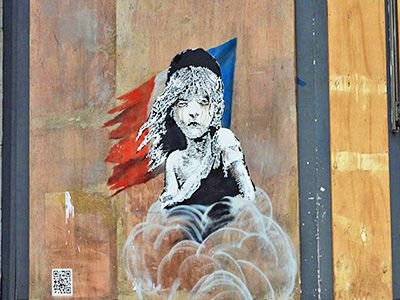
A month later, in January 2016, a new Banksy piece appeared overnight on a building opposite the French Embassy in Knightsbridge, London. It depicted Cosette, the orphan girl from Victor Hugo’s Les Misérables, portrayed in the famous image by illustrator Émile Bayard, with tears running down her face and a cloud of CS gas rising from a canister at her feet. The French flag hung in the background. The mural was a direct response to the enforced eviction of around 1,500 refugees from the Jungle earlier that month, during which French riot police had used teargas, rubber bullets, and water cannon. French authorities denied the use of teargas in areas where families were living.
Banksy added a new element to this piece: a QR code embedded in the mural, linking to a seven-minute video of the police operation filmed by Calais Migrant Solidarity. According to art world observers, it was his first interactive work, serving as the street art equivalent of a footnote or an evidence file. The location, directly opposite the embassy of the country being criticised, was notably pointed. Within 48 hours, the mural had been boarded up, reportedly after individuals attempted to remove it from the wall.

Bethlehem (2017)
In March 2017, Banksy opened the Walled Off Hotel in Bethlehem, four metres from the Israeli West Bank barrier. Every room faces the wall. The hotel describes itself, with deliberate candour, as having “the worst view of any hotel in the world.” All profits go to local projects; the building also houses a gallery and a museum tracing the region's history and the barrier that divides it. In October 2023, the hotel closed in response to the escalating conflict following the Hamas attacks of 7 October.
The Walled Off Hotel is, among other things, a reflection on walls and the people who build them, and on the particular cruelty of barriers that limit the movement of some individuals while leaving others entirely free. In that sense, it aligns with the broader argument of the Mediterranean rescue work: that freedom of movement is not a privilege to be granted selectively, but more like a right.

Migrant's soup kitchen, Paris (2018)
In June 2018, around World Refugee Day on the 20th, Banksy left several murals in Paris. The most discussed appeared on the wall of a migrant soup kitchen near the Porte de la Chapelle metro station in the north of the city, the same area where the temporary refugee centre known as La Bulle had stood until August 2017. La Bulle had housed approximately 2,700 people in makeshift conditions and had been dismantled an estimated 35 times before its residents were eventually bused to temporary shelters elsewhere, as part of what Emmanuel Macron had described during his presidential campaign as his intention to remove migrants from the streets and forests of France.
The mural showed a young Black painting a Victorian wallpaper pattern over a swastika. The image works on multiple levels at once: the innocence and vulnerability of the child, the ugliness of what she covers, and the ambiguity of her action, whether she is hiding the symbol, opposing it, or both. Banksy painted the scene in black and white except for the pink wallpaper pattern, which attracts attention and carries emotional significance.
The placement was clear. The wall of the soup kitchen marked where the migrants were; the nearby refugee centre was closed. Vandals later altered the mural to invert its message, making it seem as though the girl were drawing rather than erasing the swastika, a change that, as observers noted, revealed the very hostility the original image aimed to critique.
Former Paris Mayor Anne Hidalgo publicly praised the mural, stating on social media that sometimes a picture is worth a thousand words, and emphasising humanity and pragmatism over populism, a remark widely seen as a pointed reply to Macron's stance on migration.
Banksy’s London pop-up shop (2019)
In 2019, Banksy opened a pop-up shop in London called Gross Domestic Product. Among the items for sale were welcome mats, produced by women living in Greek refugee camps, made from life vests that had washed ashore after boats crossing the Aegean sank. The object that had kept someone alive became, in their hands, an ironic domestic item: a mat bearing the word ‘Welcome,’ made from the evidence of how unwelcome the people who wore those vests had actually been.

The migrant child, Venice (2019)
During the Venice Biennale in May 2019, a new Banksy piece appeared just above the waterline on the canal-facing wall of the Palazzo San Pantalon in the Dorsoduro district. It depicted a child in a life vest holding a pink smoke flare, a figure symbolising the thousands of children who had crossed the Mediterranean in those years, and the distress signals sent by those who did not survive the crossing. Banksy confirmed the work on Instagram. It is one of only two pieces in Italy officially attributed to him.
The mural's placement was integral to its meaning. Situated just centimetres above the canal, it seemed at high tide to be drowning, a child slipping beneath the water of one of Europe's most renowned cities, in a country that had borne the heaviest burden of Mediterranean arrivals. Venice, a city built on water and shaped by centuries of maritime trade and movement, was a deliberate choice.
The work became a tourist destination, marked on maps and visited by crowds. But the Lagoon was also destroying it. The rising water level and the corrosive effects of saltwater steadily eroded the painted surface from the moment it appeared. By 2025, roughly a third of the mural had deteriorated. That year, the Fondazione Giorgio Cini and the ARCHiVe project had already taken the precaution of recording the mural in high resolution, producing a facsimile accurate enough to capture individual water stains and the texture of the crumbling brickwork, a recognition, as the Factum Foundation noted, of the urgent need to preserve cultural heritage before it is lost.
In July 2025, restorer Federico Borgogni, working overnight from a barge, detached the section of wall bearing the mural and transported it to a laboratory. The operation was funded by Banca Ifis, an Italian bank that had recently acquired the palazzo.
The aim is to stabilise the work and display it publicly once restoration is finished. Not everyone approved. A local artist told Euronews that Banksy had been fully aware his waterside creation was not built to last, and that restoring it went against his intentions. The debate echoes older arguments about relocating works never meant to survive. The Goya paintings, now on canvas in the Prado, were once on the walls of a house, but it takes on a particular edge when the artist is still alive, and the work's ephemerality may have been deliberate.

The Louise Michel (2020)
In 2019, Banksy sent an email to Pia Klemp, a German captain whose NGO rescue vessel had been impounded by Italian authorities after she refused to hand rescued migrants back to the Libyan coastguard. “Hello Pia,” it read. “I’ve read about your story in the papers. You sound like a badass. I am an artist from the UK, and I’ve made some work about the migrant crisis; obviously, I can’t keep the money. Could you use it to buy a new boat or something?”
Klemp initially thought it was a joke, but it was not. Using proceeds from his artwork sale, Banksy bought a former French customs vessel, swift at up to 28 knots—much faster than the larger NGO rescue ships then operating in the Mediterranean. He painted it himself with a fire extinguisher, in hot pink. On one side, a girl in a life vest holds a heart-shaped safety buoy, a twist on his famous ‘Girl with Balloon.’ The ship was named the Louise Michel, after the nineteenth-century French anarchist and feminist. It departed secretly from the Spanish port of Burriana in August 2020.
In its first week, the Louise Michel rescued 89 people from a distressed rubber dinghy, then encountered another vessel carrying 130 migrants. With more passengers than it could safely accommodate, it issued a distress call; eventually, all those rescued reached Italy. Banksy announced the vessel’s existence on Instagram with characteristic dryness: “Like most people who have made it in the art world, I bought a yacht to sail around the Mediterranean.”
The Louise Michel has continued to operate, albeit with difficulties. In March 2023, Italian authorities detained the vessel for 20 days after it carried out four rescue operations in a single day, in violation of a law that bans ships from conducting multiple rescue trips. The crew clearly stated the law’s purpose: to prevent people from being saved. The ship has stayed at sea.
The Louise Michel signifies something profoundly different from Banksy’s other works on migration. The murals and installations encourage reflection; the ship requires nothing — it simply goes where people are drowning and rescues them. That an artist funded it using proceeds from paintings sold in galleries is one of the most striking ironies in recent cultural history.
Banksy, the invisible artist with a powerful voice
Banksy has maintained his anonymity for over 30 years, and his representatives continue to contest any attempts to identify him. It is widely believed that he started in the Bristol graffiti scene in the early 1990s, initially working freehand before perfecting the stencil technique that became his hallmark. His work expanded from Bristol to London and eventually appeared on walls, bridges, and galleries worldwide. He also directed the 2010 documentary Exit Through the Gift Shop, which was nominated for an Academy Award.
A 2026 investigation by Reuters, based on police records, travel documents, and interviews, identified the artist as Robin Gunningham, born in 1974 in Yate, near Bristol. This conclusion was previously reached, although less definitively, by the Daily Mail in 2008 and by researchers at Queen Mary University of London in 2016. Banksy’s representatives have challenged the findings. In a BBC interview recorded in 2003 and rediscovered in 2023, the artist, when asked his name, replied: “It’s Robbie.”
His anonymity itself serves as an argument. A named artist becomes a personality; a personality draws biography, fame, and the allure of the art market. Banksy’s choice to remain unidentified keeps the focus on the work, which, ultimately, is where he clearly wants it. The suited man on Waterloo Place, with a flag over his face, moving blindly forward: whoever created him, the point remains.
Sources and Methodology
This article draws on reports from The Art Newspaper, the BBC, The Guardian, artnet News, France 24, and designboom; the Wikipedia entry on The Son of a Migrant from Syria (which includes primary source citations such as Banksy’s direct statement); the MV Louise Michel’s official website (mvlouisemichel.org); the Arab News archive; and Encyclopædia Britannica and Reuters for biographical information. Banksy has issued very few public statements; where opinions or intentions are mentioned, they are attributed either to named third-party observers or to The Immigrant Times.
Further reading from The Immigrant Times: Fritz Lustig - And his Cello came too || Germany without immigrants, a film || Vilcek Foundation championing American immigrants || Roubaix Statue of Liberty ||

COMMENTS
FOLLOW