
Updated: Aug 22
Spain to entice immigrants to rural areas to curb population decline
Population density in some provinces has dropped to unsustainable levels
By The Immigrant Times
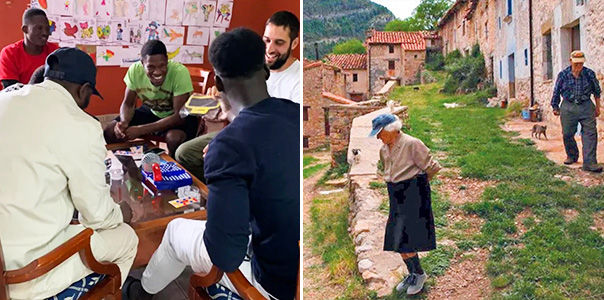
Local attitudes towards immigrant settlement differ. In some rural areas, the arrival of immigrant workers and families has been seen as an economic lifeline, while in others, opposition has been stronger, fuelled by cultural unfamiliarity. (Photo: The Olive Press)
Introduction
June 2026: Spain is trying something that no other large European country has attempted on a large scale: using immigration strategically as part of rural policy. As cities struggle with rapid population increases, the Socialist government led by Prime Minister Pedro Sánchez is encouraging immigrants to settle in the country's declining inland areas, a vast, ageing region that has been losing population for decades.
The scale of the problem is striking. Over 4,000 of Spain's 8,131 municipalities are experiencing severe depopulation, and in certain provinces, population density has dropped to a level the European Union considers demographically vulnerable. Meanwhile, Spain's foreign-born population has increased from one in twenty residents to nearly one in five in less than twenty-five years, a faster change than almost any other advanced economy, including the United States.
The government's response is a new national strategy for rural areas, overseen by Francesc Boya, Secretary-General for the Demographic Challenge at the Ministry for Ecological Transition. The strategy combines direct funding for integration programmes, support for immigrant entrepreneurs, and incentives channelled through regional governments. The sums involved are modest, €52 million in grants last year, rising to at least €80 million in 2026, and officials are candid that this is a long-term project, not a quick fix.
But the politics are volatile. Opposition from the conservative People's Party (PP) and the far-right Vox party is fierce, immigration has become one of the leading concerns among Spanish voters, and a general election due by early 2027 is expected to shift power to the right. Whether the strategy survives a change of government is an open question.
While Spain’s cities flourish, many rural areas are starved of people
The phenomenon known as España Vaciada, or Emptied Spain, is not new. The rural exodus that sped up during Spain's industrial growth in the mid-twentieth century has persisted almost without interruption ever since. Younger generations have left for Madrid, Barcelona, Seville, and the coastal cities; older generations have passed away; and schools, medical centres, and bus services have closed, making those who stay even more likely to leave.
The statistics show a slow decline. Spain's National Institute of Statistics (INE) reports that 22 million Spaniards live in the 100 most populous municipalities, roughly 44 per cent of the total population, concentrated in just four per cent of the country's territory. In Castilla y León (north-western Spain), one of the most affected regions, population density has fallen to 26 people per square kilometre. In its province of Soria, it is only 8.6 per km², below the EU's threshold of 9 inhabitants per km², highlighting demographic vulnerability. Teruel, in Aragón (north-eastern Spain), is slightly better at 9.1.
Between 1996 and 2021, 87.9 per cent of municipalities in Castilla y León and 77.7 per cent in Aragón experienced net population decline. Soria province alone has lost over 23 per cent of its population in recent decades. A study by the Centre for Demographic Studies at the Autonomous University of Barcelona found that 1,840 municipalities are at risk of irreversible depopulation, villages with an average of 110 inhabitants, a population density of 4.3 per km², and a mean age of 60.
The consequences extend into everyday life. In parts of Soria, patients have reported ambulance journeys of 2.5 hours to reach hospitals in Valladolid or Salamanca. Bus routes have been cut. Schools that once served a dozen children have closed. Bars and bakeries, the social fabric of rural Spanish life, are shutting down as their owners retire and no successors step forward.
The España Vaciada (Empty Spain) movement, which grew out of localised protest groups such as Soria ¡Ya! and Teruel Existe, staged a 50,000-person demonstration in Madrid in 2019 and has since entered electoral politics, winning seats in regional assemblies. Its grievance is structural: decades of public investment favouring cities have created a vicious cycle in which declining services accelerate out-migration, which in turn further justifies service cuts.
Spain has become a country of immigration
Spain's experience with immigration over the past 30 years has seen one of the most rapid demographic transformations in modern European history. In the mid-1990s, foreign-born residents made up about 5 per cent of the population. Today, according to official figures, nearly ten million foreign-born residents live in Spain, representing almost twenty per cent of the total population of nearly 50 million.
Most non-EU immigrants come from Morocco, Colombia, Venezuela, and Ecuador, reflecting Spain's historical and linguistic links with North Africa and Latin America.
Since 2022, Spain's foreign-born population has increased by approximately 665,000 annually. This growth has been the main factor behind the overall rise in population: Spain's birth rate of 1.1 children per woman is the lowest in the European Union after Malta, while its life expectancy of 84 years is the highest in the EU. Without immigration, Spain's population would be experiencing a structural decline.
Foreign workers have become vital to economic performance. An influx of immigrant labour, mainly from Latin American countries, has helped Spain become the world's fastest-growing advanced economy over the past two years, surpassing most of its EU counterparts. Immigrants mainly work in agriculture, construction, hospitality, domestic work, and care services. In the agricultural south, seasonal migrant workers have been a fixture for decades.
In January 2026, the Sánchez government announced a comprehensive regularisation programme, the seventh in Spain's democratic history, that will grant temporary residency and work permits to approximately 500,000 undocumented migrants currently residing in Spain.
Yet despite, and partly because of, Spain's openness to immigration, a notable imbalance has developed. Foreign-born residents now make up nearly 20 per cent of Spain's total population, but only nine per cent in low-density rural municipalities.
Immigrants are mainly urban, drawn to cities where employment is concentrated and communities from their countries of origin are already established. The challenge the government faces is not the total number of immigrants but how they are spread out.
A government plan to provide an alternative to overcrowded cities
The centrepiece of the government's approach is the Second National Strategy for Territorial Equity and the Demographic Challenge, presented by Prime Minister Sánchez in February 2026. The strategy is overseen by Francesc Boya, Secretary-General for the Demographic Challenge, who has been frank about both the ambition and the limits of what the government can do.
"Without immigration, rural Spain faces a very difficult future," Boya told the Financial Times. "The only way to sustain what we might call balanced population structures is by bringing new settlers into rural areas. While some of those new settlers may come from the cities, many will come through immigration."
Boya is equally clear about what the strategy is not. Compulsory relocation is explicitly off the table. "That could sound like something from a dictatorship," he told the FT. Saying: “Right, now we're going to move people around.” No, of course not." The government's role, he emphasises, is to create conditions, through funding, support services and incentives, that make rural settlement an attractive option for people who might otherwise remain in cities where housing is unaffordable, and overcrowding is acute.
In practice, the strategy functions through three main channels. First, the central government funds rural councils, companies, and non-profit organisations to develop reception and integration programmes for incoming migrants. These programmes include language classes, guidance on schooling, medical care, tax obligations, and practical aspects of rural life. The central government's grants for such projects totalled €52 million in 2025 and are expected to increase to at least €80 million in 2026.
Second, the government is collaborating with the non-profit Fundación Raíces to expand its activities from urban centres to rural areas. The foundation identifies young, vulnerable migrants living in state-run reception centres and assists in placing them in employment in less populated municipalities — a structured pathway from urban reception centres to rural integration.
Third, the church-linked Talento 58 foundation is running a programme to connect immigrants with rural businesses whose owners are nearing retirement age: bakeries, supermarkets and bars that would otherwise close when their proprietors stop working. The initiative tackles a specific gap in the rural economy, the problem of generational succession, while also creating opportunities for immigrant entrepreneurs.
A fourth initiative predating the current strategy is the Holapueblo project, which connects entrepreneurs seeking to relocate to the countryside with municipalities actively seeking new residents. A significant portion of its funding has come from the EU's post-pandemic NextGeneration funds, which are scheduled to conclude in 2026, raising questions about its long-term sustainability without continued national budget support.
The Cepaim Foundation's Nuevos Senderos (New Trails) programme, operating since 2002, presents a long-standing model. Between 2019 and 2023, across eight provinces, it delivered personalised relocation and integration plans for over 1,000 family units and about 1,500 individuals, combining pre-relocation consultation with on-the-ground support upon arrival.
Investment in rural infrastructure and public services to attract people
The success of any rural repopulation plan, whether for immigrants or urban Spaniards, depends on a key question: whether the infrastructure and services necessary for a decent life can be restored to communities from which they have been gradually withdrawn.
Spain's rural service gap is well-known. In the most sparsely populated areas, medical care has been reduced to occasional visits rather than resident doctors. School closures have forced families to transport their children long distances for basic education. Public transport links have been cut back as passenger numbers have dropped, creating a reliance on private cars that disadvantages elderly residents and families on low incomes.
The disparity between rural and urban provision is precisely the grievance that fuels the España Vaciada movement. Its activists argue, with substantial evidence, that service reductions themselves are a cause of depopulation, not merely a consequence. Restoring services to declining communities is therefore a prerequisite for attracting new residents, rather than something that can be deferred until populations recover.
Boya directly recognises this. The government's strategy specifically aims to reduce urban-rural inequality in services, infrastructure, and economic opportunities. The 2030 National Strategy for Demographic Challenge, which the current strategy builds upon, includes programmes for digital connectivity, the creation of innovation centres in vulnerable areas, and annual subsidies to revitalise economically depressed territories. Achieving full territorial broadband connectivity was a stated goal for 2025.
For immigrant settlers specifically, the practical challenges are worsened by language and cultural unfamiliarity. Navigating a rural Spanish health system, enrolling children in schools, and registering with local authorities requires a level of administrative confidence that newly arrived migrants, especially those from non-Spanish-speaking countries, may lack. The integration programmes funded through the national strategy are specifically designed to address this gap, offering the practical support that can distinguish between a settlement that becomes established and one that fails.
The example of Villagatón, a municipality in Castilla y León with just over 600 residents, offers a case study in what successful rural immigrant settlement can look like. A local factory manufacturing parasols and fences employs a workforce that is about eighty per cent composed of immigrants from Senegal, Gambia and Colombia. The community that has developed around this employer provides both the economic rationale for settlement and the social infrastructure, informal networks, shared experience, and mutual support that make staying viable.
The regions and provinces facing depopulation
The regions most affected by rural depopulation, Castilla y León (north-western Spain), Castilla-La Mancha (central Spain, south of Madrid), Extremadura (western Spain, bordering Portugal), and Aragón (north-eastern Spain), are also the main focus of the government's rural strategy. The Ministry for Ecological Transition has allocated grants specifically to municipalities with fewer than 10,000 inhabitants in these four autonomous communities, with individual project funding ranging from €2.5 million to €8 million.
These regions share a common profile: large areas, low population densities, ageing populations, and economies traditionally reliant on agriculture and livestock. They are also, except for Extremadura, often politically contested territory.
Castilla y León and Aragón have recently been governed by PP-led regional administrations, sometimes in coalition with Vox, parties that oppose the Sánchez government's immigration policy at the national level. The result is a structural tension between central government ambitions and regional government priorities, complicating implementation on the ground.
Local attitudes towards immigrant settlement are varied. In some communities, the arrival of immigrant workers and families has been seen as an economic lifeline, attracting customers to local businesses, preventing school closures, and providing working-age adults where the dependency ratio has become unsustainable. The Villagatón example is among several cases where immigrant labour has supported rural industries that might otherwise have shut down.
In some cases, resistance has been more pronounced, driven by cultural unfamiliarity, concerns about the pace of change, and, in some instances, political mobilisation by Vox.
The España Vaciada movement, while broadly supporting policies to reverse depopulation, has its own vision of rural revival, centred on infrastructure investment and economic growth rather than mainly on demographic replacement through immigration.
The government has been cautious to present its strategy as complementary to, rather than a replacement for, broader rural investment. Boya is keen to portray immigration not as a solution imposed on rural communities but as part of a wider package that includes connectivity, transport, healthcare, and economic opportunities. Whether that framing is accepted will depend partly on how the strategy is communicated locally and partly on whether the broader infrastructure investment comes to fruition.
Conservative and far-right parties oppose the government’s rural strategy
The Sánchez government's rural immigration strategy is closely linked to the broader political struggle over immigration that has intensified in Spain over the past two years. The January 2026 regularisation programme, the open-door stance towards labour migration, and the new rural strategy have all become targets for the conservative and far-right opposition.
Vox, which explicitly positions itself as an anti-immigration party, has described the regularisation as ‘an invitation to illegal immigration’ and campaigned across Spain under the slogan 'Not a single one more.' The party has proposed the mass deportation of undocumented immigrants and supports 'national priority' policies that would prioritise Spanish citizens in access to social housing, public employment, and welfare services.
The PP, Spain's main centre-right party, has criticised the government's immigration approach as irresponsible and poorly timed, although its stance is complicated by the fact that PP administrations oversaw two of Spain's previous six regularisation programmes.
In several regional governments, the PP has formed coalition agreements with Vox, which have led to a rightward shift in regional immigration policies, including prioritisation rules for Spanish families in social housing queues and proposals to limit the share of migrant children in certain schools.
The electoral arithmetic is unfavourable for the Sánchez coalition. Current polls indicate that the PP is around 32 per cent, the PSOE at 28.6 per cent, and Vox at 17.6 per cent. The incumbent PSOE-Sumar leftist coalition holds only about 43 per cent of seats in parliament, which is insufficient for a majority and depends on the support of Basque and Catalan nationalist parties, whose backing is conditional and episodic. A general election must be called by early 2027.
The political risks for the government's rural strategy are already evident. In the May 2026 regional election in Andalusia, Spain's most populous region, Vox became a kingmaker, poised to join a PP-led coalition government. In an earlier regional election in Aragón, one of the main target regions for the rural depopulation strategy, the Socialists lost a fifth of their seats while Vox doubled its representation.
State pollster CIS surveys show that immigration is among the main concerns for Spanish voters, cited by 20.3 per cent of respondents, ranking second only to the housing shortage at 42.8 per cent. The two issues are viewed as closely linked: widespread urban immigration is seen as a key factor driving up housing costs in Madrid and Barcelona, and the government's effort to shift that pressure towards rural areas has yet to gain enough public attention to change the narrative.
Boya, for his part, takes the long view. "We're just getting started," he told the Financial Times. The architects of the rural strategy are aware that the demographic change they are attempting cannot be measured in electoral cycles. But whether the institutional architecture they are building, the funded programmes, the non-profit networks, the regional incentive structures, will survive a change of government in 2027 is the central uncertainty hanging over the entire endeavour.
Sources and methodology
Depopulation statistics are obtained from Spain's Instituto Nacional de Estadística (INE) and research by the Centre for Demographic Studies at the Autonomous University of Barcelona (UAB). Immigration and demographic data come from INE and the Spanish Ministry of Inclusion, Social Security and Migration. The government's rural strategy is reported from the Second National Strategy for Territorial Equity and the Demographic Challenge (February 2026) and the EU Rural Pact Community Platform. Quotes from Francesc Boya are sourced from an interview published by the Financial Times (May 2026). The January 2026 regularisation is analysed by the Real Instituto Elcano (April 2026) and The Conversation (March 2026). Electoral data are drawn from PolitPro poll aggregation and the Olive Press.
Terminology
This article uses the term ‘immigrant’ to refer to foreign-born individuals residing in Spain, regardless of their legal status. The term undocumented refers to individuals residing in Spain without a current valid residence or work authorisation; the terms irregular and unauthorised are used interchangeably with the same meaning. The term regularisation refers to a government process by which undocumented individuals are granted legal residence and/or work status. The Immigrant Times does not use the term illegal immigrant as a noun to describe people.
Further reading from The Immigrant Times: Social benefits for foreigners in Europe || Spain issues Work permits to undocumented migrants || Immigrant workers boost Spain’s economy || Teaching refugees in Spain || Solidarity Prize candidate Legazpi, Spain || The Riace model ||

COMMENTS
FOLLOW